
It seemed darkly fitting that my area of the Pacific Northwest would see heavy rainfall and record-breaking floods as I was finishing work on my article about T-Mobile’s disaster response programs. I was reminded, looking at the gray skies outside my window, that natural disasters come in all sizes and intensities, and often without much advance warning.
During my visit to T-Mobile’s headquarters in November, where I got an in-depth tour of how the company’s emergency management teams restore network functionality during natural disasters, I asked everyone: “What keeps you up at night?”
“How many hours do you have?” said John Saw, T-Mobile president of technology and chief technical officer.
Network resiliency is what keeps him awake.
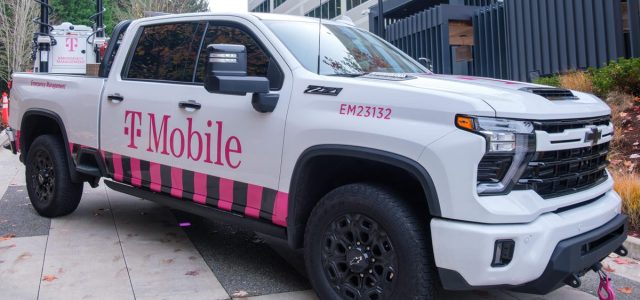
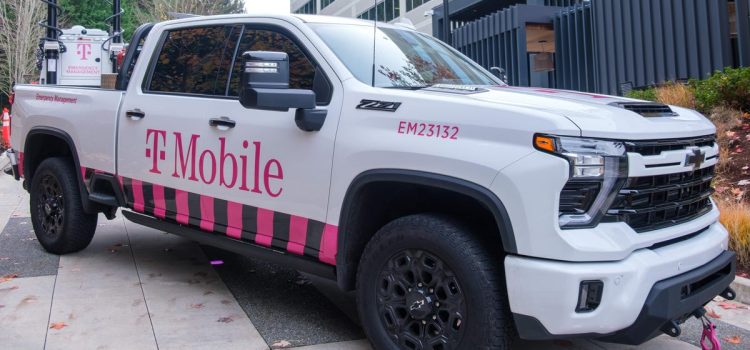
When a disaster strikes, T-Mobile’s emergency response teams mobilize from staging areas all over the US to restore the company’s cellular network. That can involve rolling out SatCOLTs (satellite cell on light trucks) or drones that create temporary 5G network coverage when cell towers are damaged, as well as providing generators where the power is out. They also help communities, in coordination with local and federal first responders, by handing out emergency supplies and portable chargers to people in need.
“Let’s make sure that our network never goes down, because we will be letting someone down if we do that,” Saw said. When it comes to disaster response, Saw said the team puts boots on the ground to make sure affected communities have access to the best technology available.
A Wi-Fi and charging truck deployed during the flooding in Kerrville, Texas in 2025.
What do other recovery professionals worry about? For several, it’s how climate change is fueling the recurrence and magnitude of major weather events.
“The way that the climate is changing has increased the different types of disasters and spread them to new locations,” said Stacy Tindell, senior director of T-Mobile’s network engineering and operations. “We have wildfires where we haven’t seen them before. We have hurricanes later into the season.”
Not only does this require more resources, but it also places greater demands on the professionals tasked with reconnecting neighborhoods and communities.
“Disaster response, it’s an adrenaline-filled situation, right? It’s go, go, go. It’s short bursts,” Tindell continued. “Generally speaking, the more that becomes every day, it’s really hard to maintain and sustain, for the network [and] for the people.”
What she doesn’t worry about is the team’s ability to shoulder the load. “Reacting and responding is what we do best,” she said.
The back of a SatCOLT vehicle showing the masts that extend to provide portable cellular service.
Emergency response is as much about preparing for “blue sky” days — when there isn’t an active disaster yet — as it is about reacting during “gray sky” days, when resources and personnel are engaged on the ground to restore cellular connections.
Over the last decade, the company’s emergency response capabilities have grown significantly, said Jon Freier, T-Mobile’s chief operating officer. In 2015, Freier traveled to Baton Rouge, Louisiana, to assist T-Mobile employees affected by devastating flooding. “I saw a couple of our competitors with a pretty big presence,” he said, “and I saw us with a couple of people with big hearts and not a whole lot of support to be able to help.”
From there, T-Mobile resources scaled up considerably in the US. The company wouldn’t publicly share how many assets, such as cellular trucks and generators, are at its disposal, or how many warehouses it uses to stage its resources. However, Freier said that T-Mobile, with a customer base of 140 million, has invested tens of millions of dollars in gear and infrastructure to get to where it’s at now.
Although some emergency response deployments are planned, such as during major sporting events like the recent Formula 1 Las Vegas Grand Prix, the team is mostly tasked with reacting as quickly as possible to unexpected incidents.
“It’s the frequency and the intensity of disasters that are happening,” said Nicole Hudnet, national lead for T-Mobile’s Emergency Response team. “It’s not a matter of if, it’s when. [I want to] make sure we’re always prepared.”
I asked if Hudnet felt increased pressure now that people are more reliant on their cell phones, since that’s one of the only ways to contact others during an emergency. “I don’t look at it as pressure, but more of a commitment we have to our communities,” Hudnet said. “If there is a flood, the small flood is just as important as the big flood to those communities.”
